Imhotep and the Stairway to Heaven: The Story of Saqqara
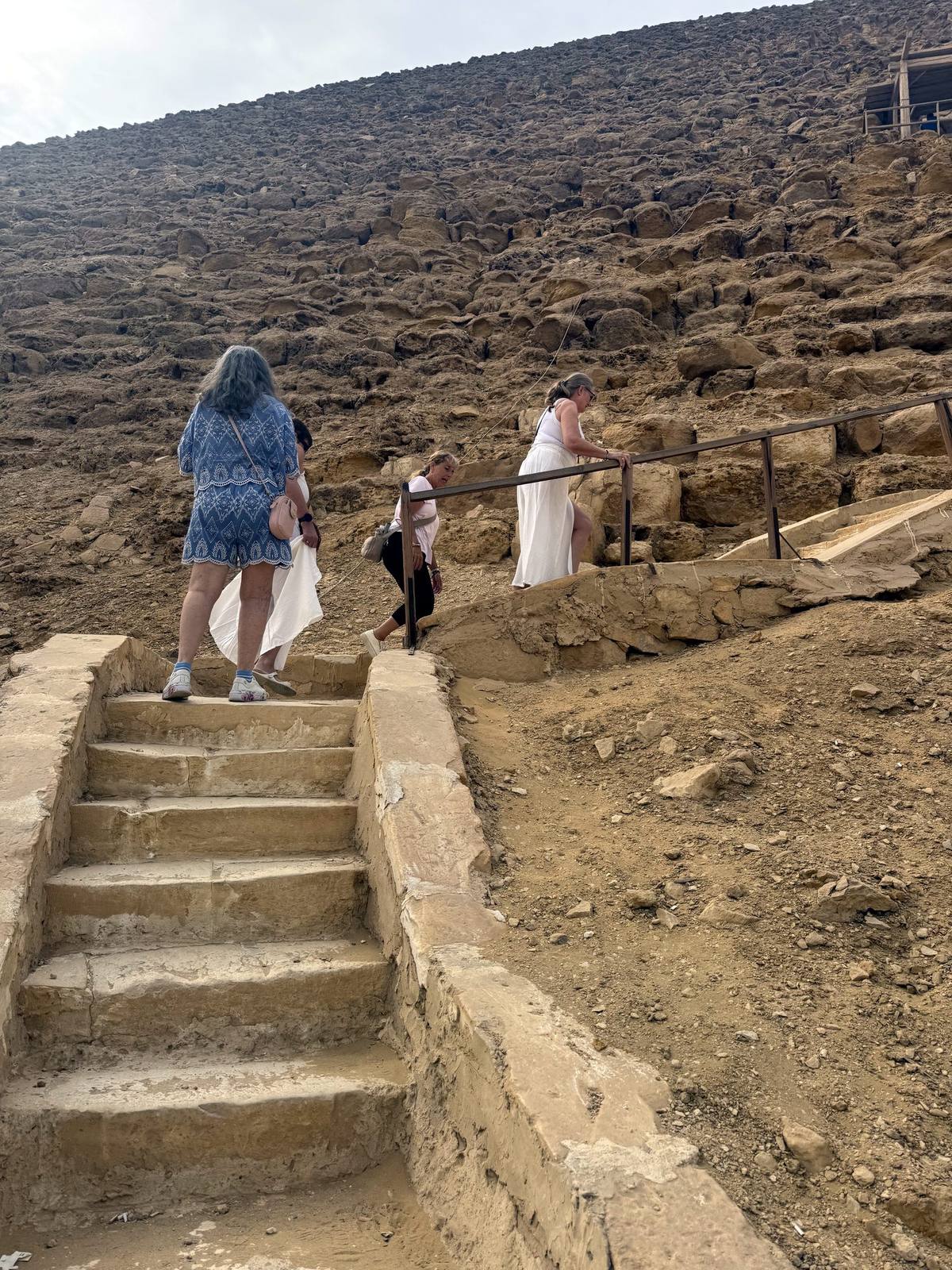
Every great journey begins with someone daring to build what has never existed.
Nearly five thousand years ago, on a desert ridge overlooking Memphis, a man looked at the low mud-brick tombs of the kings who had come before and imagined something else entirely. Something made of stone. Something that would rise, step by step, toward the sky.
His name was Imhotep.
The Architect of Eternity
Imhotep served King Djoser of the Third Dynasty, around 2650 BCE. A statue base found at Saqqara lists his titles: chancellor of the king, first after the king, administrator of the great palace, high priest of Heliopolis, builder, sculptor. He was, it seems, a genius of many arts.
For Djoser he designed what Egyptologists regard as the earliest large-scale cut-stone monument in the world: the Step Pyramid at Saqqara. It began as a single flat-topped tomb, a mastaba. Then another, smaller one was placed on top. Then another, and another, until six great steps rose against the sky. Around it stretched a vast enclosure of courtyards and shrines, all in stone, carved to imitate the reeds, wood and matting of earlier buildings, as though the impermanent world had been frozen into eternity.
A Stairway to the Stars
Why steps? The Pyramid Texts, carved inside later royal pyramids at Saqqara, speak of the king ascending to the sky: on the rays of the sun, on the wings of a bird, on a ladder, a staircase. Many scholars read the Step Pyramid as just such a stairway, a way for the king’s spirit to climb to join the circumpolar stars, “the imperishable ones” that never set.
The idea is simple and immense. Death is not an ending but an ascent. The soul climbs.
The Man Who Became a God
Imhotep’s story did not end with his death. Over the centuries his reputation grew until he was remembered as a sage, a writer of wisdom and above all a healer. By the Late Period he was worshipped as a god, son of Ptah. The Greeks identified him with Asclepius, their god of medicine. Pilgrims came to Saqqara seeking cures, and sick people slept in sacred precincts hoping for healing dreams.
It is one of history’s most remarkable transformations: an architect who became a divine healer. And it carries a truth the mystery traditions treasure. When you build in alignment with the sacred, your work outlives you and keeps healing.
Your Stairway
The Step Pyramid offers the seeker a beautiful image of the Great Work. You do not leap to the summit. You build one level at a time.
- The first step is foundation: honest ground, the truth of where you are.
- The middle steps are practice: each new layer of understanding resting on the one beneath.
- The summit is not an achievement but an opening, a place where you meet the sky.
The alchemists described the Great Work in stages, too: nigredo, albedo, citrinitas, rubedo. Each one prepares the next. Skipping stages, they warned, ruins the work.
And Imhotep’s life adds one more teaching. Your gifts may begin as a craft, a skill, a profession. But when offered with devotion, they can become medicine for others. That is what it means to bring your Great Work into the world.
- What are you building that has never existed before?
- Which step are you on right now, and can you honour it rather than rushing to the top?
- How might your work become healing for others?
Ascending
Kristina often speaks of the Great Work as the gifts we’ve set aside, waiting to be brought into relationship. In her words: “The work you’d love to bring into the world, if you could see how all the pieces fit.”
Imhotep saw how the pieces fit. One step on top of another, until stone touched sky.
A Practice: Building Your Steps
Imhotep’s genius was to stack one level upon another until stone touched sky. This practice turns that image into a map for your own ascent.
- Draw six steps on a page, wide at the bottom and narrowing toward the top, like the Step Pyramid.
- At the summit, write the vision you hold for your life or your Great Work.
- On the lowest step, write where you truly are today. Be honest; this is your foundation.
- Fill in the steps between with the stages you sense you must pass through: skills to learn, wounds to heal, courage to find.
- Circle the step you are on now. Write one action you can take this week to build it more solidly.
- Revisit your pyramid each month. Notice how the steps change as you climb.
Many seekers feel frustrated that they are not yet at the summit. Imhotep’s monument offers a gentler perspective: every step is part of the stairway to heaven. The lower levels are not lesser; they hold everything above them. Honour the step you are on, and build it well, and the ascent will take care of itself.
Read More on the Blog
Feel called to walk this path?
Book a private call with Kristina to learn about the retreats: The Great Work Pilgrimage, or a one-to-one Private Initiation Journey, where Kristina holds personal initiations and activations for you at Egypt’s sacred sites.
Book a private call with Kristina