Thoth, Hermes and the Emerald Tablet: The Secret Formula of the Great Work
A handful of lines. Some say they hold the whole of creation, and I think they hold you too.
For more than a thousand years, alchemists, mystics and philosophers have returned to a short, cryptic text called the Emerald Tablet. Isaac Newton translated it. Countless seekers have meditated on its most famous phrase: as above, so below.
In this article we’ll explore what the Emerald Tablet actually is, the Egyptian god Thoth and his fusion with Hermes Trismegistus, what the text says, and how it can guide your own Great Work.
Thoth: The Divine Scribe of Egypt
Thoth was the Egyptian god of wisdom, writing, magic and the measurement of time. He was shown as an ibis-headed man or as a baboon. He recorded the weighing of the heart in the judgement of the dead, and was credited with inventing hieroglyphs, the “words of the gods”.
His great cult centre was Khemenu, which the Greeks called Hermopolis, in Middle Egypt. It lies not far from Amarna, the city of Akhenaten, whose story I share in Akhenaten and the Aten.
From Thoth to Hermes Trismegistus
When the Greeks came to Egypt, they identified Thoth with their own messenger god, Hermes. Over time a figure emerged called Hermes Trismegistus, “thrice-great Hermes”, regarded as a sage of immense antiquity. A body of writings in Greek, known as the Hermetica, was attributed to him. They were composed in the early centuries CE, but they carry the flavour of Egyptian wisdom and were treasured in the Renaissance as ancient revelation.
What Is the Emerald Tablet?
The Emerald Tablet (in Latin, the Tabula Smaragdina) is a short text attributed to Hermes Trismegistus. The earliest known versions survive in Arabic, in works dating from roughly the eighth to tenth centuries. It was translated into Latin in the twelfth century and became a foundational text of European alchemy.
It’s important to distinguish it from a much later book, The Emerald Tablets of Thoth-the-Atlantean, published by Maurice Doreal in the twentieth century. That is a modern work with its own following, but it is not the historical Emerald Tablet.
What Does It Say?
Translations vary, but the core teachings are usually rendered along these lines:
- That which is below is like that which is above, and that which is above is like that which is below, to accomplish the miracle of the one thing.
- All things came from the One, by the meditation of the One.
- The Sun is its father, the Moon its mother; the wind carried it in its belly; the Earth is its nurse.
- Separate the earth from the fire, the subtle from the gross, gently and with great skill.
- It ascends from earth to heaven and descends again to earth, receiving the power of above and below.
Alchemists read these lines as a recipe for the Philosopher’s Stone. Mystics read them as a map of the soul. Both readings point to the same journey: separation, purification and reunion.
As Above, So Below: The Key to the Great Work
“As above, so below” is the principle of correspondence. The cosmos is mirrored in the human being. The temple mirrors the body (as Schwaller de Lubicz proposed of Luxor Temple). The stages of the Great Work mirror the stages of your life.
And “the Sun is its father, the Moon its mother” speaks directly to the sacred marriage: the solar and lunar, masculine and feminine, joined to create something new. You can explore this further in What Is Hieros Gamos?
A Word of Discernment
Lisa Renee’s Ascension Glossary discusses many esoteric groups and teachings, and encourages careful discernment about where spiritual information comes from. I share that spirit here. Not every text attributed to Thoth or Hermes is ancient, and not every teaching is benevolent. Read widely, feel deeply, and trust what resonates in your own heart.
My Own Thread
I didn’t go to Egypt to find a tablet. I went following a thread. As I wrote after visiting Amarna:
The teachings I work with describe experiences as leaving imprints in our energetic field. They speak of dormant codes activating through an encounter with a place, a sound, an experience.
Perhaps the Emerald Tablet is one of those encounters. A few lines that, read at the right moment, become a vibrational key finding its lock.
A Simple Emerald Tablet Practice
- Read the lines aloud slowly, once a day for seven days.
- Choose one line that catches somewhere in your chest.
- Journal: where in my life is this already true? Where is it asking to become true?
- Notice what changes in your dreams, your choices and your attention.
Thoth’s Wisdom in Egypt’s Temples
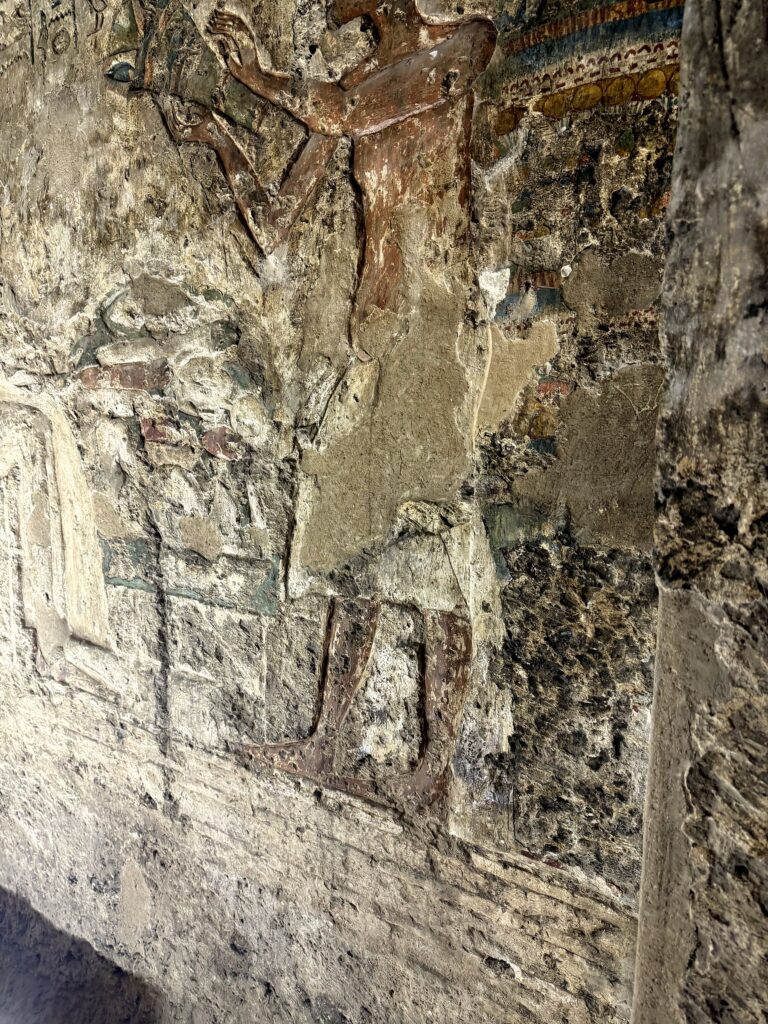
Although the Emerald Tablet itself comes from a later era, Thoth is everywhere in Egypt’s sacred art. You’ll see him as an ibis-headed scribe, pen in hand, recording the result of the weighing of the heart. At Hermopolis, colossal quartzite baboons of Thoth still stand among the ruins. In temples along the Nile, he appears beside the king in purification scenes, pouring streams of ankh signs, the symbols of life, over the royal head.
Standing before those images, the Hermetic principle becomes tangible. The divine scribe records, measures and balances. Above and below are held in right relationship. And the seeker is invited to do the same: to write a new story, to measure their life by the truth of the heart, and to bring heaven and earth into harmony within.
Frequently Asked Questions
What is the Emerald Tablet?
It is a short Hermetic text attributed to Hermes Trismegistus, known from Arabic sources of roughly the 8th to 10th centuries and later translated into Latin, foundational to European alchemy.
Did Thoth write the Emerald Tablet?
Tradition attributes it to Hermes Trismegistus, a figure linked with Thoth. Historically, the earliest surviving versions are in Arabic and much later than ancient Egypt.
Where does ‘as above, so below’ come from?
The phrase is a popular paraphrase of a line in the Emerald Tablet expressing the correspondence between the heavens and the earth.
Is the Emerald Tablet the same as the Emerald Tablets of Thoth?
No. The Emerald Tablets of Thoth-the-Atlantean is a twentieth-century book by Maurice Doreal, separate from the historical Emerald Tablet.
Where was Thoth worshipped?
Thoth’s main cult centre was Khemenu (Hermopolis) in Middle Egypt.
Continue the Journey
If this article stirred something in you, these may be the next threads to follow:
- The Black Earth Within: Why the Great Work Begins in Egypt
- Akhenaten and the Aten: The Mysteries of Amarna, City of the Sun
- Atlantis in Egypt? The Lost Lineage Behind the Temples
Your Invitation
On The Great Work Pilgrimage, as above, so below becomes something you feel in your body: the temples outside mirroring the temple within.
👉 Discover the Great Work Pilgrimage
Not sure yet? Book a free 20-minute discovery call and we’ll feel into whether this is your season.
The formula has been waiting for you. Come closer.
With love,
Kristina
Leave a Reply