Raising the Djed: The Story of Abydos
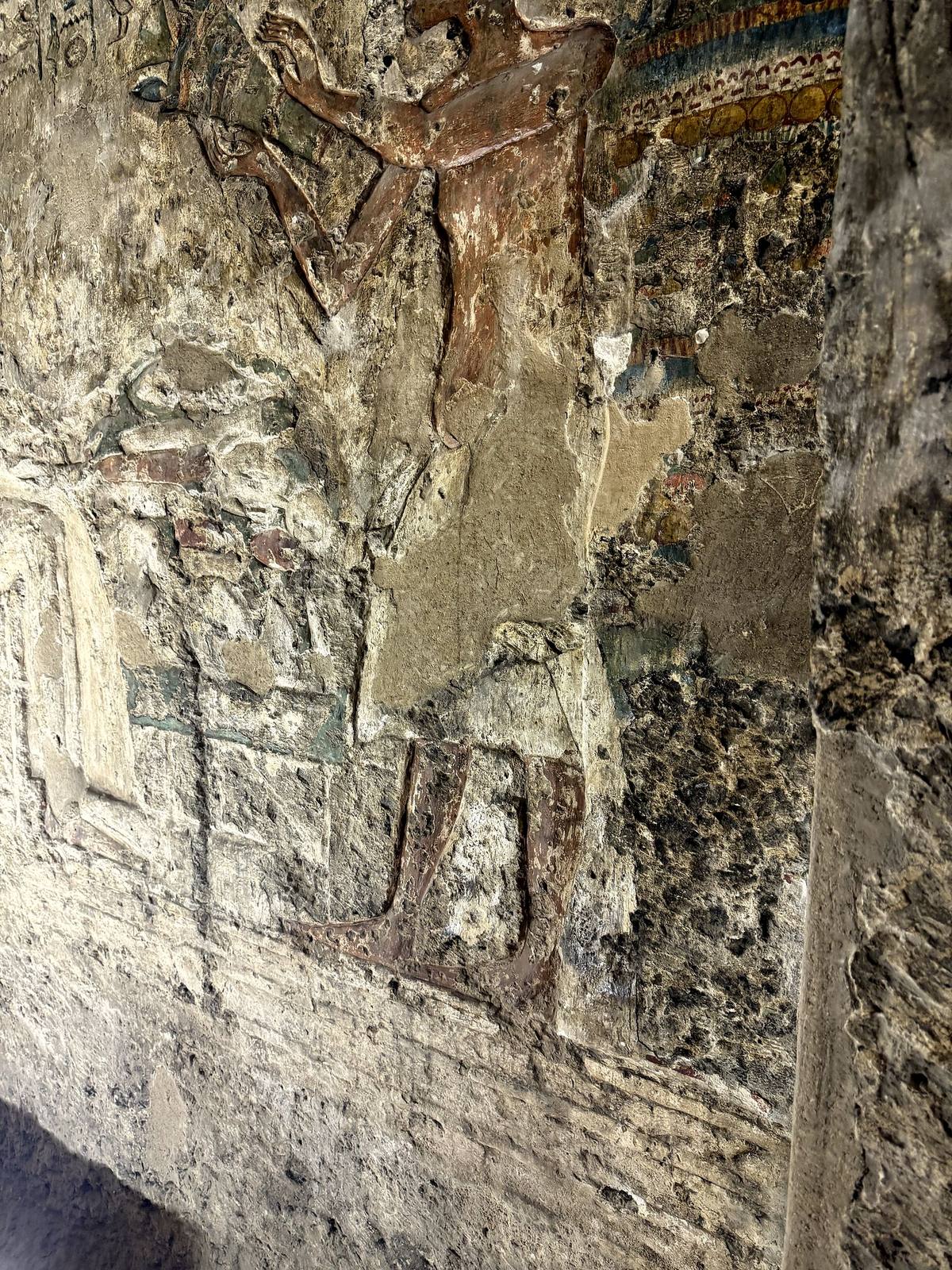
At the end of the festival, they raised the god’s spine.
It was the last day of the month of Khoiak, as the floodwaters were retreating and the fields were ready to be sown. In temples across Egypt, and above all at Abydos, the sacred city of Osiris, priests gathered around a tall pillar lying on the ground. They took hold of the ropes. And slowly, with chanting, they hauled it upright.
The Egyptians called it the Djed. It meant stability, endurance. And it was said to be the backbone of Osiris.
The Murdered King
Osiris was the good king, murdered by his brother Set, his body scattered across Egypt. His wife Isis searched the land and gathered the pieces. Through her magic, he was restored and became lord of the underworld, ruler of the dead, god of resurrection. You can read the whole myth in Isis and Osiris: The Love Story That Raised the Dead.
Abydos was his sacred city. Tradition held that his head was buried there, and a tomb of one of Egypt’s earliest kings came to be honoured as the tomb of the god himself. For thousands of years, Egyptians longed to make the pilgrimage to Abydos, or at least to set up a memorial stone there, so that they might share in Osiris’s resurrection.
The Mysteries
Every year, Abydos held the Mysteries of Osiris. A stela left by the official Ikhernofret, sent by King Senusret III nearly four thousand years ago, describes his role. He refurbished the god’s sacred barque and statue. He led the procession of Wepwawet, the jackal god, “the opener of the ways”. He repelled the enemies of Osiris in a staged battle. He accompanied the god to his tomb and back again to his temple, in triumph.
Some parts of the festival were public: processions, crowds, dramatic re-enactments. Others took place in secret. We do not know all that happened. But at its heart was a story of death and return.
The Pillar That Stands
The Djed pillar was one of Egypt’s oldest symbols, a column with four horizontal bands at its top. Its origins are debated; it may have begun as a sheaf of grain or a pole wrapped with crops. By the New Kingdom it was firmly identified with Osiris’s spine. Amulets in its shape were placed on mummies, so that the deceased would stand upright again in the afterlife.
The raising of the Djed was the moment of resurrection: what had fallen, stood. What had been scattered, was made whole. Kings performed the ritual themselves at great jubilees, sometimes with the queen beside them.
The Osireion
Behind the magnificent temple of King Seti I at Abydos lies the Osireion, a strange structure of colossal granite pillars, often half-flooded, regarded by Egyptologists as a symbolic tomb of Osiris dating to Seti’s reign. Some alternative researchers believe it is far older. Explore the debate in Abydos and the Flower of Life.
Raise Your Djed
Every seeker knows what it is to fall. To be scattered by grief, illness, betrayal or change. To lie, as it were, on the ground, waiting.
The story of Abydos says: you can stand again. Not because you never fell, but because something deeper than the fall holds you up. The Djed is the inner spine of the soul, its stability and endurance. The Great Work is, in part, the raising of that spine.
- What has fallen in your life that is ready to stand again?
- What gives you stability when everything else shifts?
- Who are the ones holding the ropes with you?
Notice that the Djed was never raised alone. Priests, kings, queens, whole communities hauled on the ropes. Resurrection was a shared act. This is why we journey in a held circle: so that when it is time to stand, you are not pulling alone.
Kristina has written of the Great Work beginning with a pull you can’t ignore: “You follow one thread. Then another. You don’t know where it’s leading. But you know how alive you feel when you get close.” At Abydos, the thread leads to the oldest promise in Egypt: what is scattered can be gathered, and what has fallen can rise.
A Practice: Raising Your Djed
The raising of the Djed pillar was the moment of resurrection. This embodied practice lets you feel that stability in your own spine.
- Lie down on your back for a few minutes. Let your body be heavy, like the pillar lying on the ground.
- Bring to mind something in your life that has fallen: a hope, a strength, a part of yourself.
- Slowly roll to your side and come up to sitting, feeling each vertebra of your spine stacking upward.
- Rise to standing, as if invisible ropes are drawing you upright. Feel your feet on the earth and the crown of your head lifting.
- Place your hands on your lower back and say quietly: I stand again.
- Stand for a full minute in stillness. Notice the stability that holds you.
The Djed was placed on mummies so the dead would stand upright in eternity. For the living, it is a reminder that stability is not rigidity. It is the strength of a spine that can bend and still rise. Whatever has fallen in your life, the ancient promise of Abydos is that it can be raised, especially with others holding the ropes beside you.
Read More on the Blog
Feel called to walk this path?
Book a private call with Kristina to learn about the retreats: The Great Work Pilgrimage, or a one-to-one Private Initiation Journey, where Kristina holds personal initiations and activations for you at Egypt’s sacred sites.
Book a private call with Kristina